Your techs are finding deficiencies every single day. Cracked welds, worn wire rope, brake linings past their limit, safety latches missing or bent. They document it, hand over the report, and move on to the next job.
That’s where the money dies.
Most crane service companies treat inspection reports like paperwork, something you file and forget. But the companies that are growing right now treat every inspection report like a sales proposal, because that’s exactly what it is.
The findings are already there, and the customer already trusts you enough to let you on their floor. The only thing missing is a framework for turning “here’s what we found” into “here’s what you should approve today.”
The Problem: You’re Leaving Money on the Table After Every Inspection
Here’s what happens at most crane service companies. Your tech finishes the inspection, types up a text-only report, emails it to the plant manager, and moves on. The plant manager skims it, doesn’t understand half the code references, files it in a folder, and forgets about it.
No photos. No urgency ratings. No repair quote attached. No follow-up.
As one crane service owner put it: “You can’t really show the customer what you’ve worked on.” And if you can’t show them, you can’t sell them.
The inspection itself is a loss leader for most companies. You’re getting paid $500 to $800 for the visit, but walking away from $5,000 to $50,000 in repair and upgrade work because nobody translated the findings into a language the customer can act on.
Step 1: Use the Urgency Tiers Your Customer Doesn’t Know Exist
You already know 1910.179(j) inside and out, but your customer doesn’t. This gap is where the sale lives.
Most plant managers think “inspection” is one thing. They don’t know OSHA breaks it into frequent and periodic tiers with different cadences, different scopes, and different consequences. When you walk them through that distinction, you stop being the tech who found a problem and start being the expert who’s protecting their operation.
Here’s how to frame it:
For frequent inspection items, (j)(1): “This is something OSHA says should be checked every operating shift to every month. The fact that we caught it on an annual visit means it’s been running out of compliance for a while. Here’s what that exposure looks like for your facility.”
For periodic inspection items, (j)(2): “This falls under OSHA’s periodic inspection category, the deeper structural and mechanical review. These findings don’t fix themselves, and they tend to get more expensive the longer they sit. Let me show you what we’re looking at now versus what it looks like in six months.”
The point isn’t to educate the customer on OSHA classifications, but to use those classifications to create urgency they can feel. When you say “this is a periodic inspection finding” to a plant manager, nothing happens. When you say “OSHA expects this to be caught and addressed on a 1-to-12-month cycle, and right now you’re outside that window,” now they’re listening.
The move that separates you from your competition: Reference the specific section number in your report and in the conversation. Not because the customer cares about section numbers, but because it signals that you know the code cold, and that credibility is what gets your repair quote approved over the next company’s.
Step 2: Frame Every Recommendation in Terms of Customer Risk
Plant managers don’t think in OSHA section numbers. They think in three categories: fines, downtime, and liability.
Here’s how to translate:
Fines: “OSHA willful violation penalties hit $165,514 per incident in 2025. This finding, if left unaddressed and an inspector walks in, puts you in the serious violation category, that’s $16,550 per instance. You’ve got four cranes with the same issue. That’s over $66,000 in potential fines.”
Downtime: “Everything’s about money. The less downtime, the better for everybody.” Your customer knows this instinctively. Put a number on it. If their crane goes down for an unplanned repair, what does that cost them per hour? Per day? Most manufacturing facilities lose $5,000 to $25,000 per hour of unplanned downtime. A $3,000 repair today looks very different next to a $50,000 shutdown next month.
Liability: “If we document a deficiency today and the crane fails next quarter because it wasn’t addressed, that inspection report becomes a legal document showing the customer was aware of the issue. You’re not doing them a favor by burying it in a text-only report. You’re doing them a favor by making it impossible to ignore.”
Step 3: Get the Proposal in Their Hands Within 24 to 48 Hours
This is where most crane service companies fail. They find the problems, document the problems, and then go back to the office to “work up a quote” that takes a week, sometimes two, to send.
By then, the plant manager has moved on, or worse, your competitor got their quote in first.
The companies that are closing more repair work aren’t necessarily faster inspectors. They’re faster at turning findings into proposals. The benchmark? 24 to 48 hours from inspection to proposal in the customer’s inbox. That’s the window where the urgency from the walkthrough is still fresh, the plant manager still remembers what you showed them, and the findings haven’t gotten buried under the next fire drill.
One crane company owner described the difference: “We were literally sliding pieces of paper across a desk, big blown-up picture of a shredded gear… His face changed. And was like, OK, how much to fix this?” That reaction happened because the finding was visual, immediate, and tied to a number. Your job is to keep that momentum alive between the walkthrough and the proposal.
Here’s the workflow that makes 24 to 48 hours possible:
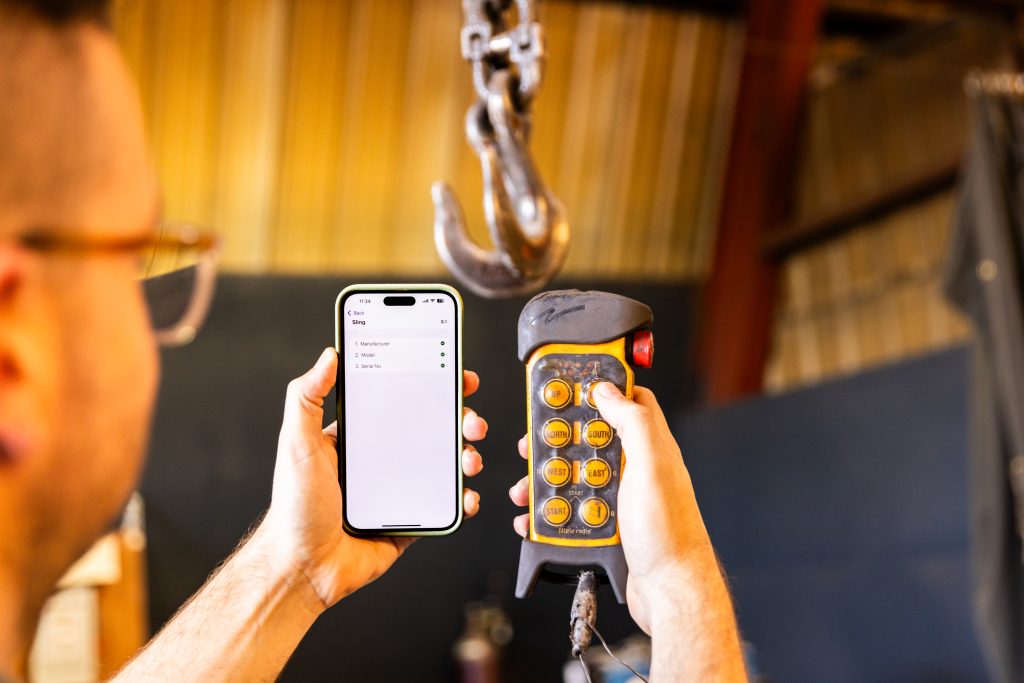
1. Document with photos during the inspection. Every deficiency gets a photo with the OSHA section number referenced. Time and date stamped. “We need the time and date stamp on the photo to justify,” as one service company owner put it. This is your proposal’s backbone. If the documentation is solid in the field, the proposal practically writes itself back at the office.
2. Categorize by urgency before you leave. Red (immediate safety hazard, crane out of service), Yellow (must address within 30 days to stay compliant), Green (monitor and plan). Do this while you’re still looking at the equipment, not from memory two days later.
3. Walk through the critical findings with the plant manager on-site. You’re not presenting a formal proposal yet, but you are setting the stage. “I found three items I want to walk you through before I leave. I’ll have the full proposal with pricing to you by tomorrow afternoon.” That conversation creates expectation and urgency. Plant managers who know a proposal is coming tomorrow treat it differently than one that shows up unannounced next week.
4. Turn it around within 24 to 48 hours. Get the proposal out while the walkthrough is still fresh. Include the photos, the urgency categories, the OSHA references, and a repair estimate, even a range works. “$2,800 to $3,400 for the weld repair, includes materials and two-day lead time.” The faster it lands, the more likely it gets approved. Reports that take a week to send get filed and forgotten.
Step 4: Follow Up Like a Consultant, Not a Vendor
The inspection report isn’t the end of the conversation, it’s the beginning.
If your customer doesn’t approve repairs on the spot, schedule a follow-up within 48 hours. Reference the specific findings, the urgency tier, and the risk. “Just wanted to circle back on the wire rope finding from Tuesday. That falls under OSHA 1910.179(j)(2) as a periodic inspection item, and given the level of wear, I’d recommend we get it scheduled in the next two weeks to avoid a potential out-of-service situation.”
This is consultative selling. You’re not pushing product, you’re showing the customer that you know the code better than their competitors’ service providers, and you’re protecting their operation.
As one owner said: “I can show you you’re actually saving money between downtime and breakdowns if you partner with us.” That’s the position you want to be in. Not the vendor who shows up once a year, but the partner who keeps their crane inspections running and their compliance tight.
The Bottom Line
Every inspection your techs complete is a revenue opportunity disguised as a compliance task. The difference between a $500 inspection and a $15,000 repair contract is how you present the findings, with urgency, visual documentation, specific OSHA references, and a quote the customer can approve before you leave the building.
The companies winning right now aren’t better technicians. They’re better at explaining why the work matters.
Download the Inspection-to-Proposal Cheat Sheet
This 2-page PDF your techs can pull up on their phone right after completing an inspection. It maps the 10 most common findings to customer-facing language, the specific OSHA/CMAA code reference, a recommended urgency level, and a sample line-item for the repair proposal. Close the gap between “here’s what we found” and “here’s what you should approve today.”