It is Wednesday morning, the second week of peak season. The phone in your dispatcher’s office has rung twelve times before nine. Three of those calls are emergency repairs at industrial accounts. Two are customers asking when crews will be on site. One is a foreman calling from a parking lot in a different state asking what happened to the parts that were supposed to ship Friday. The other six are internal.
Nobody has touched the schedule yet, the one that’s supposed to drive the day.
This is the week the cracks show. Every operation that grew through the spring is now testing whether the system actually scales. The spreadsheet that worked for five crews is failing at eleven, the dispatcher who used to know every job in his head is now hoping his foremen call him back, the customer who used to wait politely is now calling twice in the same morning, and the owner is looking at a margin number that should be climbing and isn’t.
What Peak Season Actually Costs
Peak season doesn’t break operations because of the volume. It breaks them because of the visibility. Every disconnected tool, every text-message-as-dispatch, every “let me check and call you back” gets multiplied by the number of crews in motion.
In a slow week, a missed dispatch call is a hassle. In peak season, it’s a billable day rolled forward to next week, a customer email that goes ignored for six hours, and a job site that sits idle while a tech drives in the wrong direction. By Friday, you have lost the margin you spent April building.
The pattern is the same in every operation we talk to. A dispatcher running on an Excel sheet, a Google calendar, or a magnetic board on the wall. Foremen calling the office for answers the office doesn’t have either. Owners on the phone with customers explaining things they shouldn’t have to be on the phone for.
Why “We Will Catch Up” Is the Wrong Plan
The plan most companies have for peak season is the same plan they had last year. Work longer hours, push the dispatcher harder, hope the field figures it out. It works for one week, maybe two. Then it doesn’t.
The companies that scale through peak season without losing margin have one thing in common. They stopped treating scheduling as a clipboard problem and started treating it as a primary system. When the schedule is real, in one place, and visible from anywhere, the field stops calling for answers, the office stops chasing data, and the customer stops being the last to know.
DeSHAZO replaced a 12-step weekly dispatch process with one system and cut workflow steps in half. Their dispatchers used to spend Friday afternoons and weekends manually lining up the next week. They got their weekends back, and the schedule got more accurate.
What Scheduling Has to Do in Peak Season
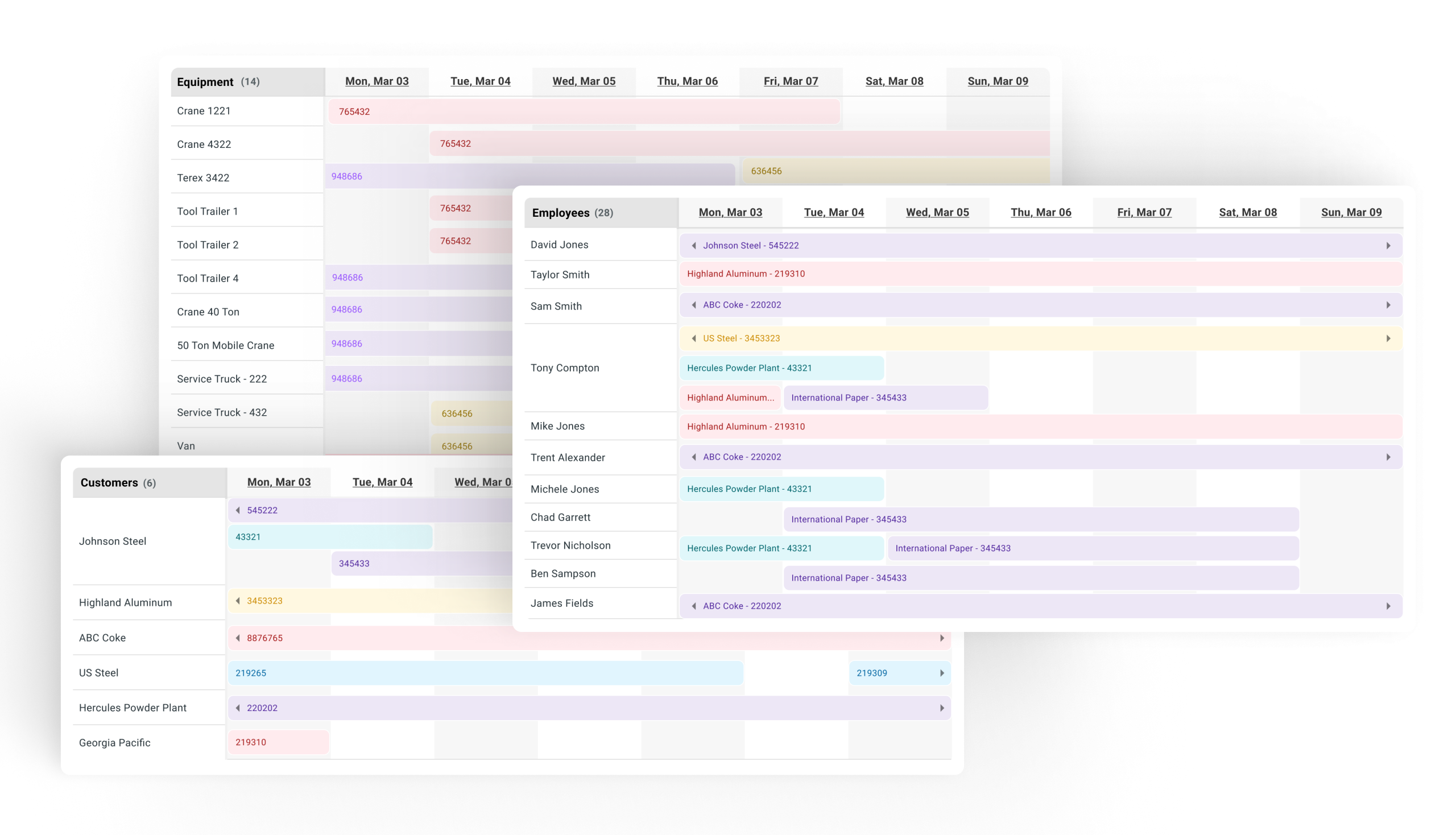
The scheduling layer for industrial field service has to do four things at once. It has to be real-time, so a job added at 2pm doesn’t get lost. It has to be mobile, so foremen and crews can see what’s changing without calling the office. It has to be connected to time, work orders, and customer records, so dispatch isn’t a separate world from billing. And it has to work where signal does not, because plants and remote sites are not WiFi hotspots.
We wrote about crewOS offline mode and why it matters, and the same logic applies to dispatch. A scheduling system that requires connectivity is a scheduling system that fails the moment your tech needs it most.
crewOS gives industrial field service teams one scheduling layer that does all four. Dispatch from one screen, push to every crew in seconds, pull job history and customer data into the same view, and keep working when the plant kills your signal. The dispatcher stops being a phone operator and starts being a planner, the office sees the same schedule the field sees, and the customer sees what’s coming next in real time.
From Catching Up to Staying Ahead
Peak season is the wrong time to fix scheduling. The companies that walk out of August with margin intact are the ones who walked into May with their dispatch already in one system. The ones who didn’t are the ones spending the rest of the year explaining what went wrong.
It’s Time To Get Started
crewOS gives you the visibility you need.
Call us Drop us a note