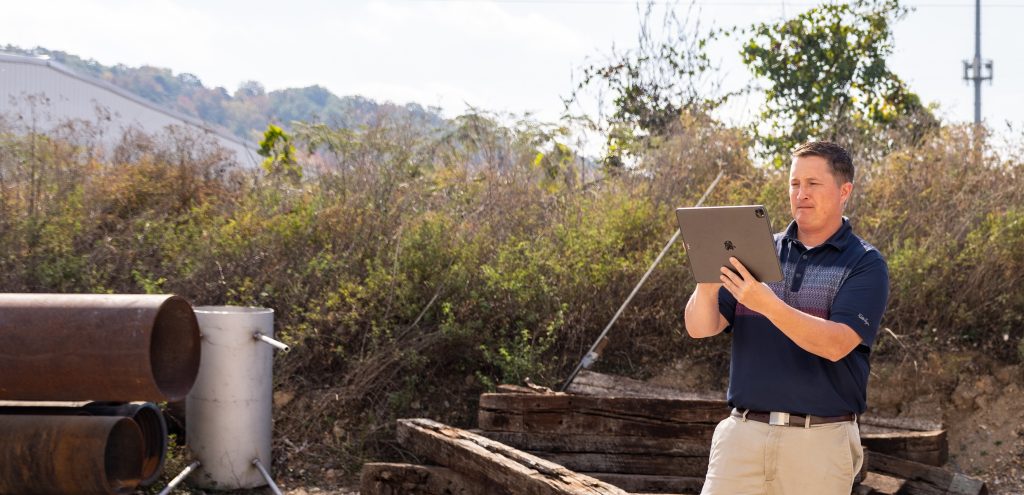
In industrial field service, the work happens where the customer’s equipment is, not where the WiFi is. Crews inspect equipment inside steel buildings, work inside plants with no cellular signal, and run jobs in remote locations where service drops out for hours. Most field service software treats that as an edge case. crewOS treats it as the default. The Offline Mode feature was built so every capability your crews need in the field works offline, with data syncing back automatically the moment they’re back in coverage.
For most industrial service companies, the connectivity gap forces a choice. Crews can rely on the system and lose half their day when the signal drops, or they can fall back to paper and lose the data when it doesn’t make it back to the office. Either way, the company pays.
Connectivity gaps become billing gaps. Forms get filled out twice, inspection findings get retyped, photos get lost between the phone and the system, and the data that should have flowed cleanly from the field to the office gets stuck inside a truck for hours or days.
The Connectivity Struggle in Industrial Service
We hear it from every industrial vertical we work with:
- Job sites with no cellular or WiFi coverage. Crane work inside steel buildings, plant maintenance in basements, refinery outages in remote yards, field service in rural areas, all environments where the signal disappears for hours.
- Software that stops working the moment the signal drops. Most field service apps freeze, lose data, or kick crews back to a login screen when connectivity is lost, forcing a return to paper.
- Paper workarounds that recreate the original problem. When crews fall back to paper because the app didn’t work offline, the company is right back where it started, with disconnected data, delayed billing, and lost detail.
- Data lost between the field and the office. Inspection findings, time entries, photos, and notes captured on a phone with no connection often never make it into the system at all.
- Doubled data entry. Crews record information once on paper in the field, then retype it into the system later, doubling the work and introducing errors.
- Delayed billing on every job. When field data is stuck on a phone or on paper because of a connectivity gap, the invoice waits, and the cash flow suffers.
How crewOS Fixes It
crewOS Offline Mode was built so every capability your crews use in the field works without an internet connection, and syncs automatically when they’re back in coverage.
Full functionality offline. Time tracking, inspections, work orders, photos, notes, JSAs, signatures, and reports all work without a signal. Crews don’t change how they use crewOS based on whether they have coverage.
Automatic sync when coverage returns. The moment a device reconnects, crewOS uploads everything captured offline in the background. Crews don’t have to remember to sync, and the office sees the data as soon as the truck hits a signal.
Local data integrity. Offline data is stored securely on the device, with no risk of loss between the field and the sync. What gets captured stays captured, even if the phone is in airplane mode for the entire shift.
No paper fallback required. Because the full crewOS workflow runs offline, crews never have to revert to paper, eliminating the most common source of doubled data entry and lost detail.
Photos, signatures, and rich documentation captured offline. High-resolution photos, customer signatures, and full inspection forms all work without coverage, building the same audit-ready record offline as online.
One unified record, regardless of where it was captured. Once data syncs, there’s no visible difference between data captured on a connected device and data captured offline. It’s all one job, one record, one source of truth.
Designed for the realities of industrial sites. Offline mode is a core feature. crewOS expects crews to work in places where coverage is unreliable, and built every workflow accordingly.
Customers describe the impact in simple terms. The day the connectivity gap stops dictating how the crew works is the day field operations actually scale.
Why Industrial Teams Need It Now
Industrial customers are pushing for faster turnaround, cleaner documentation, and real-time visibility, even on the most remote sites. At the same time, the work continues to take place inside steel buildings, in basement plant rooms, in rural locations, and on outage sites where cellular service is unreliable. Software that depends on a constant signal doesn’t fit the work.
The companies winning industrial service contracts are the ones whose tools work everywhere their crews work. The ones whose software breaks the moment the signal drops are quietly losing ground to competitors who solved the problem.
With crewOS Offline Mode:
- For managers: Confidence that every crew, on every site, captures and syncs full job data regardless of coverage, so reporting and billing don’t depend on cellular maps.
- For crews: The same workflow everywhere, without the friction of paper backups or the worry that field data will be lost between the truck and the office.
- For your customers: Faster turnaround on inspections, reports, and invoices, even on the most remote sites.
- For finance: A tighter loop between field work and billing, with no connectivity-driven delays leaking margin out of every remote job.
With crewOS, offline mode transforms from a feature checkbox into a structural advantage. The crewOS Offline Mode feature keeps your crews productive, your data clean, and your billing on schedule, regardless of where the work takes them.
Ready to Keep Working When the Signal Drops?
crewOS gives you full offline functionality, automatic sync, and clean data from every job, in every location, every time.