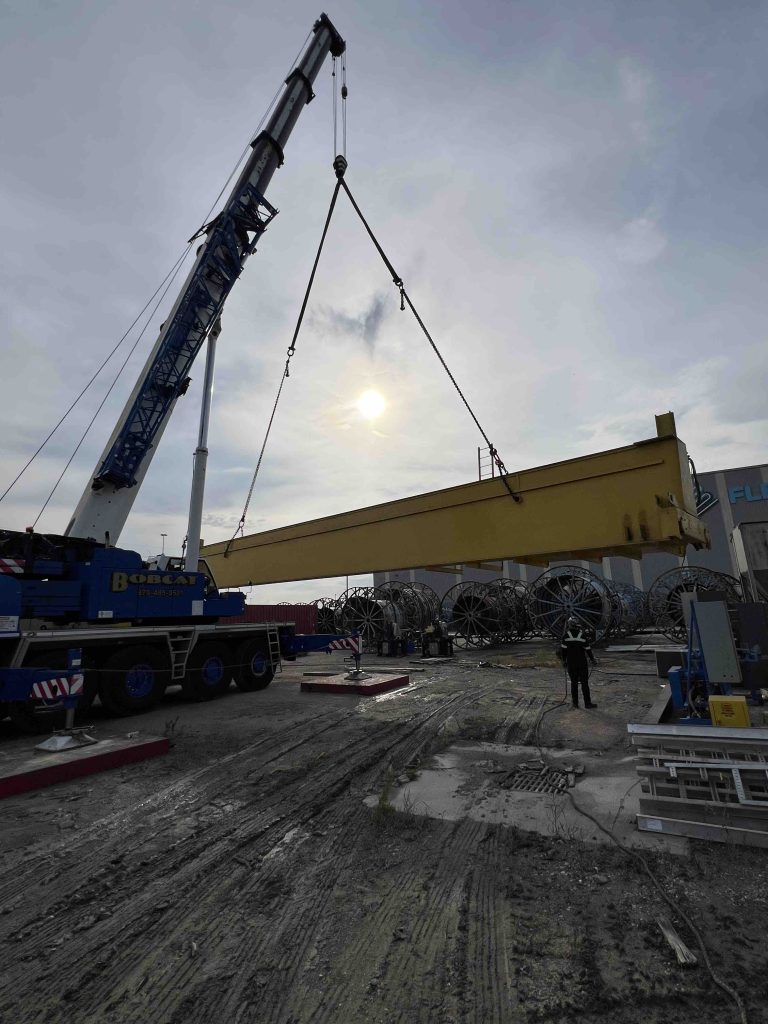
Your techs are on a crane deck right now, eyes on a gearbox or wire rope, and a plant manager is standing ten feet away waiting for answers.
What separates the tech who walks away with a signed repair authorization from the tech who walks away with a filed report? Both found the same deficiency. What separates them is code fluency.
The tech who can say “This is a 1910.179(j)(3) periodic inspection finding, and under ASME B30.2-2.1.2 it’s a shift-by-shift operational check that’s been missed” is the tech who wins the work. The one who says “this looks worn” goes home empty-handed.
This is the cheat sheet your team should know.
Why Code Fluency Closes Deals
Plant managers don’t need you to recite code. They need you to sound like the person who knows it well enough that they don’t want to argue.
When you cite a specific OSHA section, three things happen at once:
- You move from “opinion” to “regulation”
- The plant manager stops negotiating and starts listening
- Your competitor, who doesn’t cite codes, suddenly looks unreliable
That’s the sale.
The OSHA Section Every Crane Tech Should Know
1910.179 is the overhead and gantry crane standard, and most of your inspection revenue lives inside a handful of its subsections.
A few your team should be able to name on sight:
- Frequent Inspections — the daily-to-monthly visual checks your customer’s in-house team is almost certainly skipping
- Periodic Inspections — the 1-to-12-month cycle where most of the serious structural and mechanical findings surface
- Brakes — a standalone compliance category under 1910.179, not optional maintenance
If your tech can’t tie each of those findings back to a specific subsection on-site, the plant manager hears a hunch instead of a code citation. That’s where the repair work gets lost.
The Operational Standards That Close the Loop
OSHA is the legal minimum. ASME B30.2 and CMAA 78 are the operational playbook the manufacturer expects. When your tech cites the right standard for the right finding, they’re not arguing, they’re informing.
Three patterns come up again and again:
- Operational checks that the in-house operator is supposed to run at the start of every shift, and isn’t
- Preventive maintenance programs that OSHA requires in writing, and that most customers don’t have
- Modifications and alterations that have to be certified by a qualified engineer or the equipment manufacturer, and often aren’t
Each of these has specific code language behind it, and each of them turns a “we found something worn” into a documented compliance finding your customer has to act on.
The Three-Tier Framework for Every Finding
Every deficiency your tech documents should be categorized on-site, before leaving:
- Red: Immediate safety hazard, crane out of service
- Yellow: Out of compliance but not imminent hazard, must be addressed in the short term
- Green: Wear item within spec but nearing replacement, plan for it now
Your customer’s in-house team doesn’t know this framework exists, and that’s the edge. When you walk in with a tiered finding list and the code references to back it up, you’ve done what they can’t.
Give Every Tech a Pocket Field Guide
Nobody memorizes this on the first pass. That’s why the companies winning repair work have a 4-page guide in every truck: OSHA section numbers, CMAA references, the three-tier framework, and customer-facing language for each finding.
We built one. It’s free. Download the OSHA/CMAA Pocket Field Guide and put it in every tech’s glove box.
Download the Pocket Field Guide
The crane service companies closing repair work right now aren’t guessing. They’re quoting the code. Give your team the same edge.
crewOS gives you the tools you need.
Let us help you stand out against your competition.