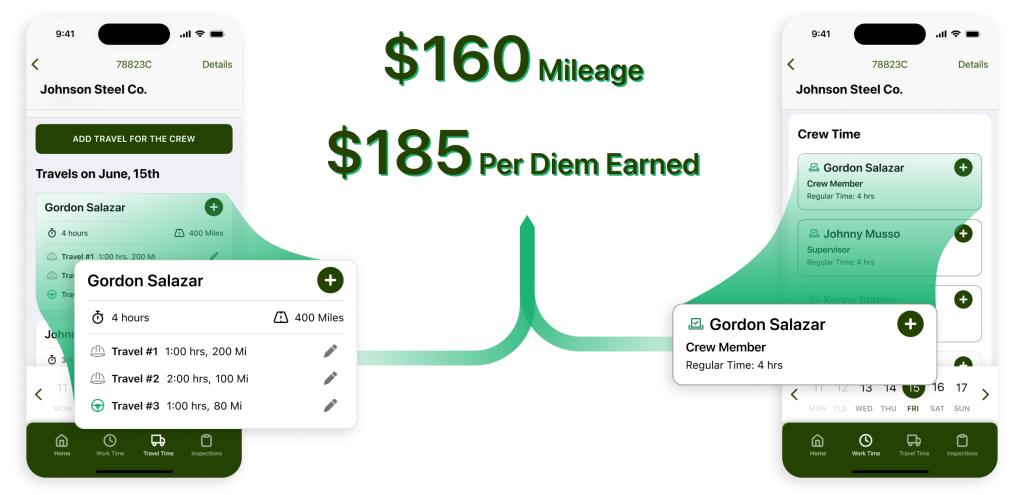
When per diem is treated as something to reconcile after the work is done, leadership loses visibility when it matters most. Travel costs surface weeks after jobs close. Payroll teams scramble to reconcile missing or inconsistent entries. Operations leaders think a job was profitable until expenses finally hit the books.
In many field service organizations, per diem disputes, late submissions, and unclear eligibility rules quietly compound. What looks like a small administrative issue becomes a recurring drain on margins, trust, and planning accuracy, all without anyone realizing where it all started.
Per Diem Isn’t Just Reimbursement Work
Every time a crew is dispatched to a job site, operations is making a financial decision. Which crew is assigned, how long they stay, and how often they travel all directly affect per diem spend.
When that data isn’t visible in real time, scheduling decisions are made without understanding their true cost. A job may appear efficient on paper, only to reveal inflated travel expenses weeks later. Over time, this disconnect makes it nearly impossible to understand which jobs, customers, or regions are truly profitable.
Per diem is a direct reflection of how efficiently the operation is planned and executed.
Pay Accuracy Keeps Crews Moving
In field service, people are the operation. Highly skilled technicians, inspectors, and operators keep jobs moving, customers satisfied, and revenue flowing. When pay is correct and predictable, crews stay focused on the work because they trust their employer.
One of the fastest ways companies lose experienced tradespeople is by getting their pay wrong.
Missing per diem, delayed reimbursements, or inconsistent eligibility creates frustration immediately. Crews who travel frequently depend on accurate, timely per diem to cover real living expenses while on the road. When payments are late or incorrect, trust is lost, distractions increase, and retention suffers.
Pay accuracy is an operational stability issue. When per diem is calculated correctly and tracked in real time, technicians spend less time worrying about corrections and more time doing the work. Crews stay willing to travel, accept assignments faster, and remain confident that the company values their time and effort.
For operations leaders, reliable per diem processes protect margins, workforce retention, project execution, and the ability to keep experienced teams on the road where they create the most value.
Real-Time Visibility Changes Everything
When per diem is tracked digitally and connected to jobs, crews, and time, it stops being reactive and starts becoming operational intelligence.
Instead of discovering overruns after the fact, leaders can see per diem costs accumulating as work happens. They can compare travel expenses across jobs, identify patterns of overuse, and adjust schedules or crew assignments before margins erode.
For field service companies supporting outages, shutdowns, and emergency work, that visibility is critical. Travel-heavy projects leave little room for error. Knowing where costs are trending, while crews are still on-site, allows teams to protect margins instead of explaining them away.
Why Per Diem Visibility Matters
For many crane and industrial field service teams, travel and per diem can add up quickly. Based on the U.S. General Services Administration’s 2026 standard per diem rates—about $178 per day for lodging, meals, and incidentals—companies can easily incur substantial daily costs when crews travel for inspections, outages, or multi-day service calls. Yet many companies don’t see those costs clearly until payroll closes, affecting the accuracy of the job costs, overall, and impacting your bottom line.
Teams using real-time per diem tracking consistently report:
- Faster payroll processing (often 30–50% less administrative time)
- Fewer reimbursement disputes with technicians
- More accurate job costing before invoices are sent
- Improved forecasting for outage and shutdown work
When per diem data is timely, structured, and connected, it becomes a control mechanism.
| Area of Impact | Without Digital Per Diem Tracking | With Real-Time Per Diem Tracking |
|---|---|---|
| Share of Job Costs | Estimated over 10-20% of total job cost often hidden until payroll | Visible as work happens |
| Payroll Processing Time | Manual reconciliation, delays, rework | 30–50% less admin time |
| Job Cost Accuracy | Expenses discovered after invoicing | Accurate costs before billing |
| Disputes & Corrections | Frequent technician follow-ups | Fewer disputes, clearer rules |
| Operational Visbility | Reactive, retrospective | Proactive, real-time insight |
| Planning & Forecasting | Based on estimates and assumptions | Data-driven scheduling decisions |
Forecasting Depends on Accurate Per Diem Data
Planning future work without reliable per diem data forces leaders to rely on estimates and assumptions. Expansion into new territories looks cheaper than it is. Staffing models break under pressure. Budgets miss the true cost of travel-heavy jobs.
When per diem is captured consistently and tied to operational data, leaders gain clarity. They can see which job types drive the highest travel costs, which customers require the most on-site time, and how per diem impacts profitability across the business.
That insight turns per diem from an expense line into a forecasting tool that supports smarter growth decisions.
Why Manual Tracking Will Always Hold Teams Back
Paper forms, spreadsheets, and disconnected apps make per diem harder than it needs to be. Manual systems lead to missed entries, delayed approvals, inconsistent rule enforcement, and unnecessary administrative work for both the field and the office.
More importantly, manual tracking prevents per diem data from being used operationally. If the information isn’t timely or structured, it can’t inform decisions. Teams stay reactive, constantly catching up instead of staying ahead.
Connecting Per Diem to the Entire Operation
Modern field service operations are moving away from point solutions and toward connected platforms where per diem, time tracking, scheduling, job costing, and reporting all live in one place.
When per diem tracking is integrated into daily workflows:
- Technicians submit per diem easily from the field
- Eligibility rules are applied automatically
- Payroll processes faster with fewer errors
- Operations sees the financial impact immediately
- Leadership gains a clear picture of true job costs
This is where per diem shifts from being a payroll headache to an operational advantage, and crewOS comes into play. With operational software that gives you full visibility into your entire operation, per diem tracking becomes a part of the automated process. You can easily see the costs associated with each job and how it affects the whole picture.
…
Ready to streamline your per diem and operations as a whole?
Let's Connect
We’ll help you gain the edge every field service operation needs.